

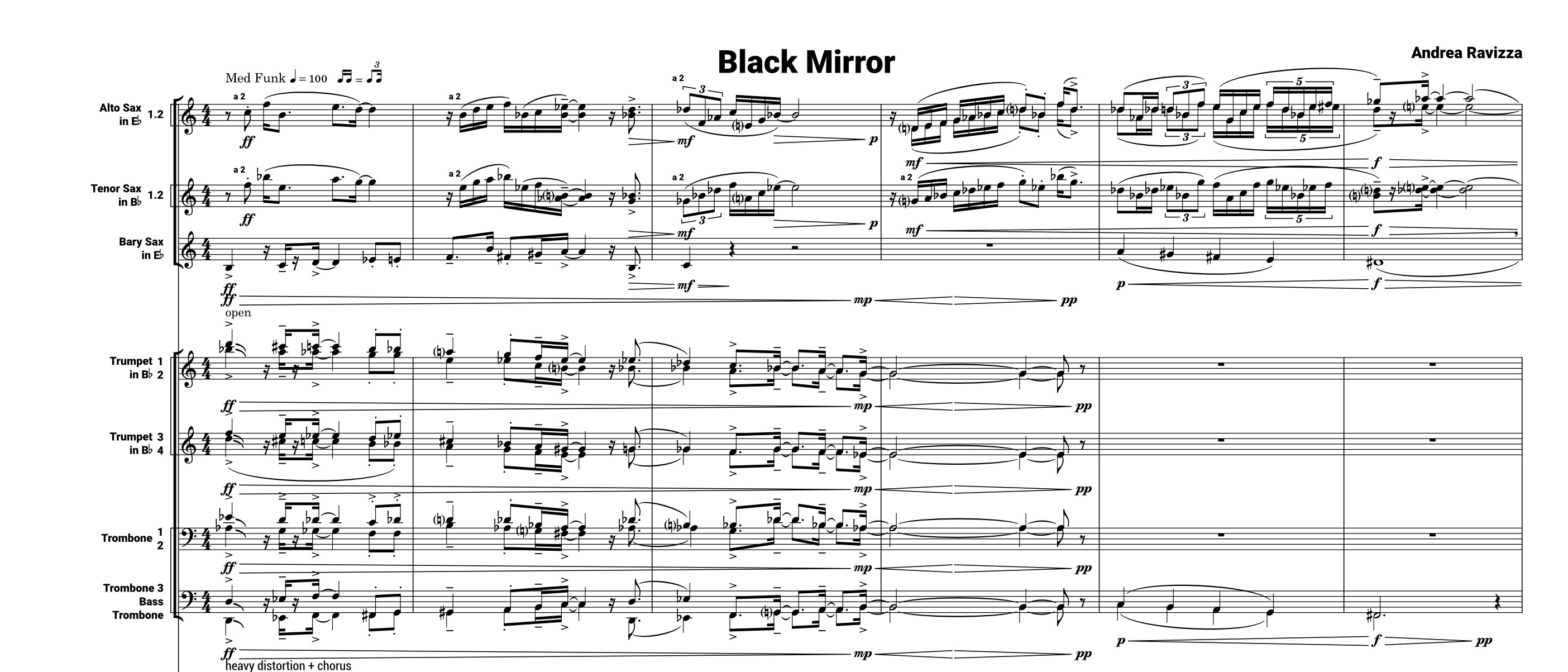

Black Mirror, composed in 2022 by Andrea Ravizza for big band, represents a deep immersion into the composer’s jazz language. The piece is dedicated to drummer Gianpaolo Petrini and was recorded by the Gianpaolo Petrini Big Band in 2022, released on the album The Big Band Is My Life (Zanetti Records).
The title itself, Black Mirror, evokes a central and programmatic concept of the work: the distortion and fragmentation of reality, similar to what can be observed through the “broken glass of a smartphone”, as in the well-known British television series. This metaphor is translated into music through two fundamental compositional principles:
Integral mirror structure
- Vertically: intervallic motion is conceived in a specular way—when the bass ascends, the upper voices almost always descend, and vice versa.
- Horizontally: the overall form of the piece is constructed with a retrograde ending in relation to the opening, and several internal sections feature specific “mirror” or retrograde moments.
All the chords used in the piece are major triads; however, the bass note is always a pitch that does not belong to the chord itself. This choice generates constant tension and a deliberate “distortion” of traditional harmonic perception, reflecting the idea of an altered musical reality.
The big band instrumentation includes saxophone sections (alto, tenor, baritone), trumpets, trombones (including bass trombone), electric guitar, piano, bass, and drums. The piece is characterized by a “Med Funk” groove at ♩ = 100, alternating moments of high energy with more reflective sections, emphasized by frequent dynamic variations.
A distinctive element of Black Mirror is the prominent role of the solo trombone (“featured trombone”). This choice is inspired by Bob Brookmeyer’s famous piece Make Me Smile, which instead features an alto saxophone. The trombone solo part is masterfully performed by Luca Begonia. The drums also feature a solo section, written in 7/8.
This compositional approach fits coherently within Andrea Ravizza’s broader aesthetic research, as already evident in earlier works such as Verdichtung and I colori di α. His constant “need to explore the unknown and the unexplored”, along with his preference for a musical language that challenges traditional harmonic conventions, fully emerges in Black Mirror. The systematic manipulation of harmonic space and temporal structures recalls his practice of using algorithms and “meta-instruments” (such as Max-MSP in Verdichtung and Frammenti) to explore new sonorities and forms, always balancing the rigor of “rules” with the sensitivity of “instinct”. The harmonic “distortion” in Black Mirror may thus be seen as an evolution of the prepared and detuned piano concept of Frammenti or the arbitrary repositioning of pitches in Verdichtung.
Instrumentation
Gianpaolo Petrini, drums
Fabio Gorlier, piano
Davide Liberti, double bass
Saxophones: Bonadé, Tardito, Corvaglia, Biggio, Data
Trombones: Begonia, Brignolo, Calcagno, Spiandore
Trumpets: Valerio, Giunta, Rapacciuolo, Cessario