


Streifen, completed in 2018, is a composition for large orchestra that reflects an in-depth investigation into new sound worlds and a musical language that goes beyond the boundaries of the tempered system and traditional tonality. The title, which in German means “stripe, band, layer”, directly alludes to the central idea of the piece: the exploration of bands of sound that compress and expand along the vertical axis of the sonic spectrum.
This work is fully embedded in a compositional aesthetic driven by the need to explore the unknown and the unexplored, and to create something new — something that did not exist before and is about to come into being. The investigation of the infinite timbral nuances of acoustic instruments, together with the desire to discover new paths, unfamiliar sounds, and unknown atmospheres, constitutes the driving force of this composition.
Key Compositional Concepts
-
Exploration of Sonic Space and Microtonality
- At the core of Streifen lies the decision to subdivide the audible frequency spectrum in new and arbitrary ways, unconstrained by traditional scales. This approach allows the exploration of sonic areas that are normally left unused.
- Microtonality plays a fundamental role. In order for intervals smaller than the semitone to be perceived clearly, an appropriate orchestral context is constructed — not intrusive, but clarifying. Toward the more forceful and sharply defined ending of the piece, microtonality gradually approaches tempered semitones for perceptual clarity, while glissandi remain as an anchor to the perception of the explored spaces.
- The concept of the threshold of perception (liminality) formulated by Gérard Grisey is particularly relevant: certain delicate phenomena require an appropriate context in order to be perceived.
-
Algorithmic Generation of Material and the Meta-instrument
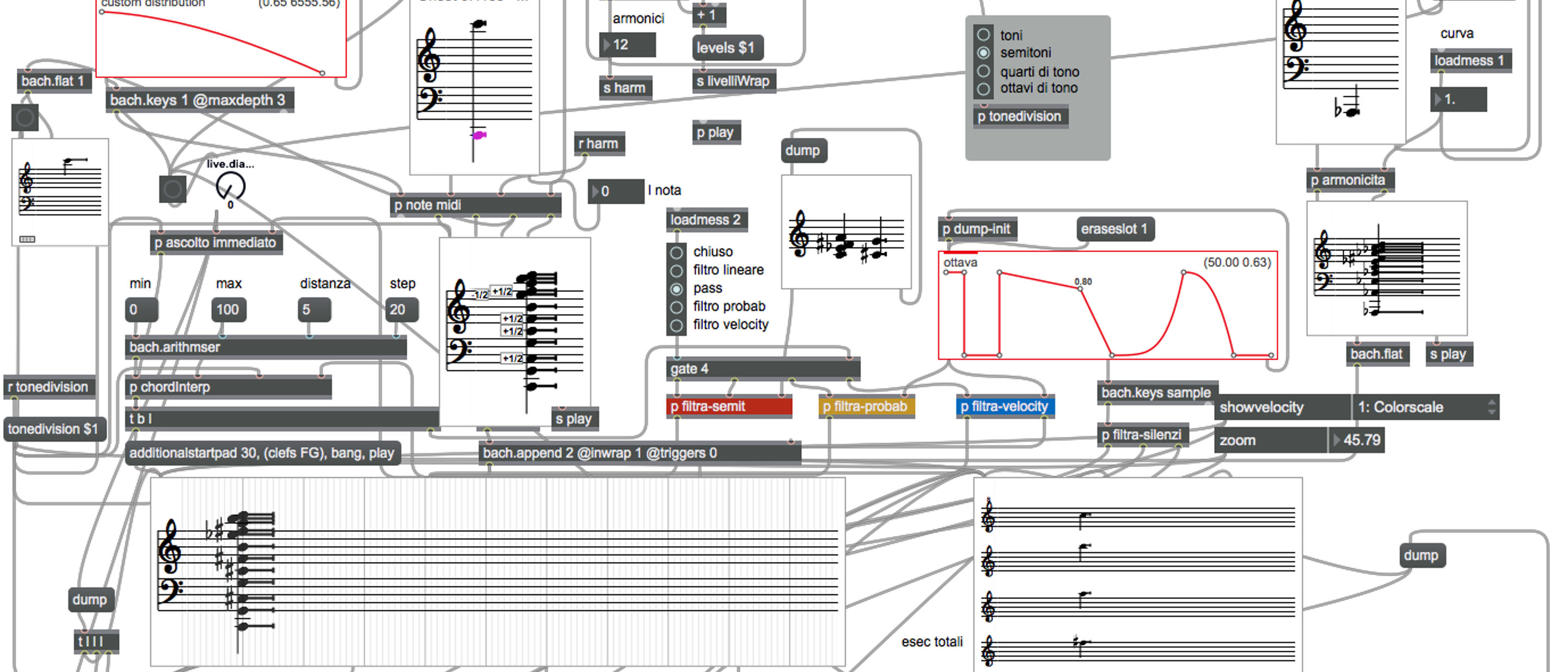
- The harmonic and thematic material of Streifen is derived from a complex system of algorithms developed within the Max-MSP environment, also making use of the bach and cage libraries. This allows harmonic, temporal, and thematic concepts to be manipulated in numerical form.
- The computer, through Max-MSP, functions as a Meta-instrument, making it possible to audition complex sonorities or sonorities incompatible with the piano, such as non-tempered chords. This tool becomes essential for evaluating the aesthetic quality of the material prior to transcription, through processes such as:
- Linear or customized subdivisions: intervallic distances are chosen arbitrarily, creating equidistant intervals or accumulating pitches upward or downward.
- Harmonicity coefficient: the values of natural harmonics can be distorted, gradually rendering the spectrum less harmonic, in a more “spectralist” approach.
- Interpolation: a technique for moving between different harmonic distributions, generating intermediate chords.
- Filters: a process called “velocity filtering” modulates the strength or presence of specific notes within an octave, influencing the overall color of the chord.
-
Time and Sonic Bands
- The concept of time is expanded, inspired by Grisey, considering the skeleton of time, the flesh of time, and the skin of time.
- The sound bands are structured not only by pitch, but also by temporal aspects. Orchestral density is dynamic, shaped by processes such as thickening and fog.
- Thickening generates new material that is harmonically coherent but chaotic in its profiles, allowing lines to be compressed or expanded in order to vary density.
- Fog is a process that creates a particulate material, in which notes have minimal durations, different subdivisions, and staggered attacks, describing a harmonic distribution with an ethereal character.
-
Compositional Techniques and Development of the Material
- Glissandi and Shepard Tone: Glissandi are widely used to make intermediate frequencies audible and to create a sense of motion, essential for the perception of moving sound bands. The Shepard Tone is an effect that creates the illusion of an infinite glissando, achieved through the superimposition of twelve phase-shifted string lines.
- Abrupt cuts: Crescendo chords, often in ff or fff, abruptly interrupt the bands, introducing new distributions or acting as hinges between different orchestral sections.
- Melodic transformation: From the vertical distributions of pitches, thematic material is derived by analyzing pitch classes and intervallic distances. A pseudo-random algorithm (bach.scramble) reshuffles pitches and durations to avoid exact correspondence, allowing control over the global speed of the melody. This process generates different melodies for each instrumental line while remaining harmonically coherent.
- Temporal stretching: Musical phrases can be expanded or compressed along the temporal axis, preserving pitch content while slowing down rhythmic motion to create a different atmosphere, as in the case of the oboe melody later restated by the trumpet.
- Tension and repose: Moments of density and sonic richness are alternated with more sparse sections, often entrusted to the percussion, allowing the listener time to process the material and creating dynamics of tension and release.
- Return of material: Previously heard gestures and melodies reappear in order to reinforce the cohesion of the piece and help the listener orient themselves within the dense musical texture.
The Orchestra as a Field of Experimentation
The instrumentation of Streifen is that of a large orchestra (3 flutes, 3 oboes, 3 clarinets, 3 bassoons, 4 horns, 3 trumpets, 3 trombones, tuba, harp, 5 percussionists, and a large string section).
In Streifen, the orchestra is not merely a vehicle for musical ideas, but a laboratory in which new models and unknown sounds come to life. The interaction between compositional instinct and algorithmic rigor is fundamental, with aesthetic sensitivity guiding the final decisions, balancing the risk of algorithmic coldness against that of falling back into stereotypes.
In summary, Streifen is a journey into the sonic unknown, where technology serves creativity in revealing a universe of timbres and musical relationships previously unexplored, offering a listening experience that is complex yet deeply coherent.